
(Nearly) all the data jobs are in London
An overview of pay, working style and location of data job adverts in nonprofits
Four years of newsletters
Back in June 2022 I started collecting links to data vacancies in non profits. I wanted to show people that there are data roles in nonprofits and help anyone interested in the sector get a handle on what is going on.
I publish these links in a short email to subscribers roughly weekly. You can subscribe here.
Data jobs
What's a data job?
It's whatever I decide it is.
I don't spend a lot of time worrying about whether to include a job or not. To some extent I include jobs that I could see myself applying for or having applied for. I am looking for jobs that are working directly with quantitative data (or managing those who work directly with the data)
It's a curated and personal list. I almost never include vacancies in universities. I often do include vacancies in national galleries. I don't include MEL vacancies unless they are also what I regard as data jobs.
This constitutes quite an interesting dataset and over the next few weeks I'll be exploring some aspects of the data.
Insights
Fresh analysis
With my colleagues at Data Orchard CIC I have published a couple of analyses in the past. Like this in 2024 and this in 2025.
For this series I've started with a fresh look at the full dataset. There are a number of judgements I've made in preparing the data which may differ to those previous analyses. So there may be apparent disagreements between them.
Adverts
As of the end of July 2026 I had listed 2,192 unique vacancies (based on my judgement of what constitutes the same advert that I accidentally included twice) from 1,095 unique organisations. I have manually classified each vacancy into one of a series of job families.

As you can see the dataset is heavily skewed. The most popular job types are Manager, Analyst and Officer. There are also enough vacancies for Head, Senior Analyst and Admin to make for some interesting analysis.
I'll be focusing on each of those in turn over coming weeks.
Salaries
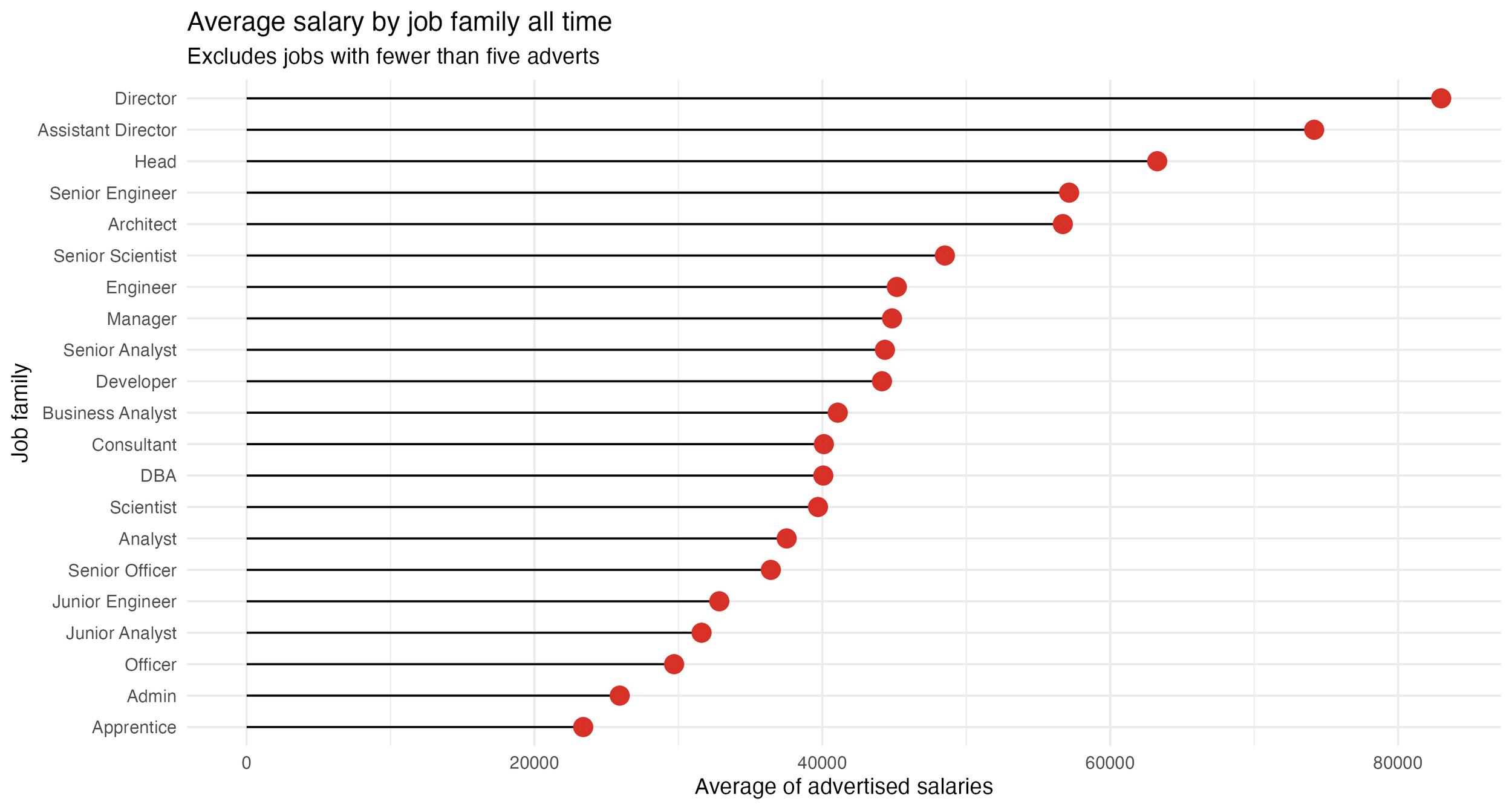
This really is very broad brush. But fun.
We probably expect that there was wage inflation over the past few years (I'll explore that in more detail for each job family in future weeks). So what you really want to know is what do people get paid right now.
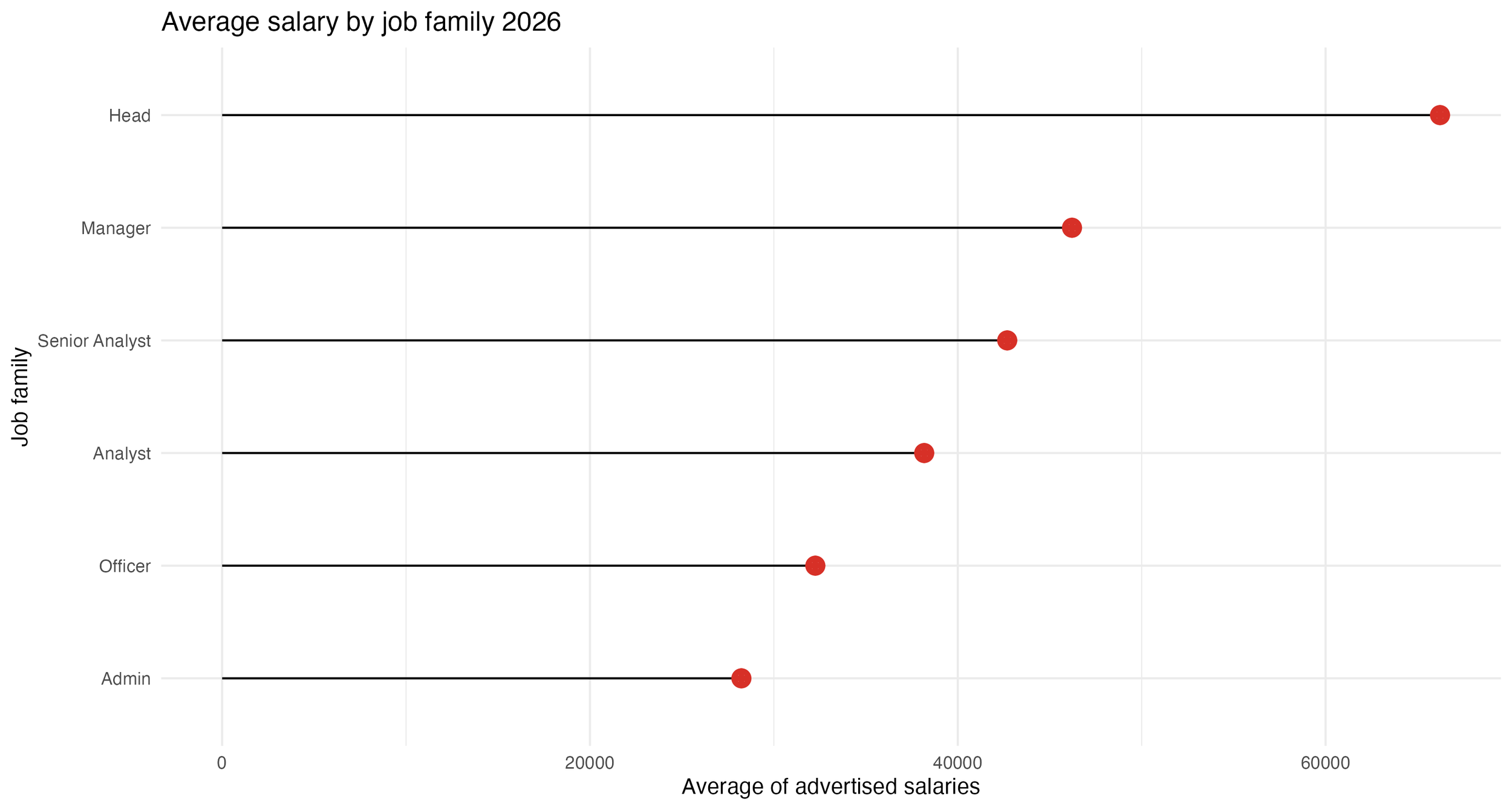
Here's the data for the key job families (i.e. job familiesI have plenty of adverts for) just for 2026 (so, in fact, the first seven months of 2026).
Working style
One thing I'm very interested in is whether jobs are on-site, hybrid or remote. For simplicity, if a job is advertised with a range of styles I'll mark it as Remote if that's an option and Hybrid if Remote is not an option. I only use "Flexible" if that's what the advert says and I can't quickly discern what they mean in my terms.
Overall this is what the market looks like.
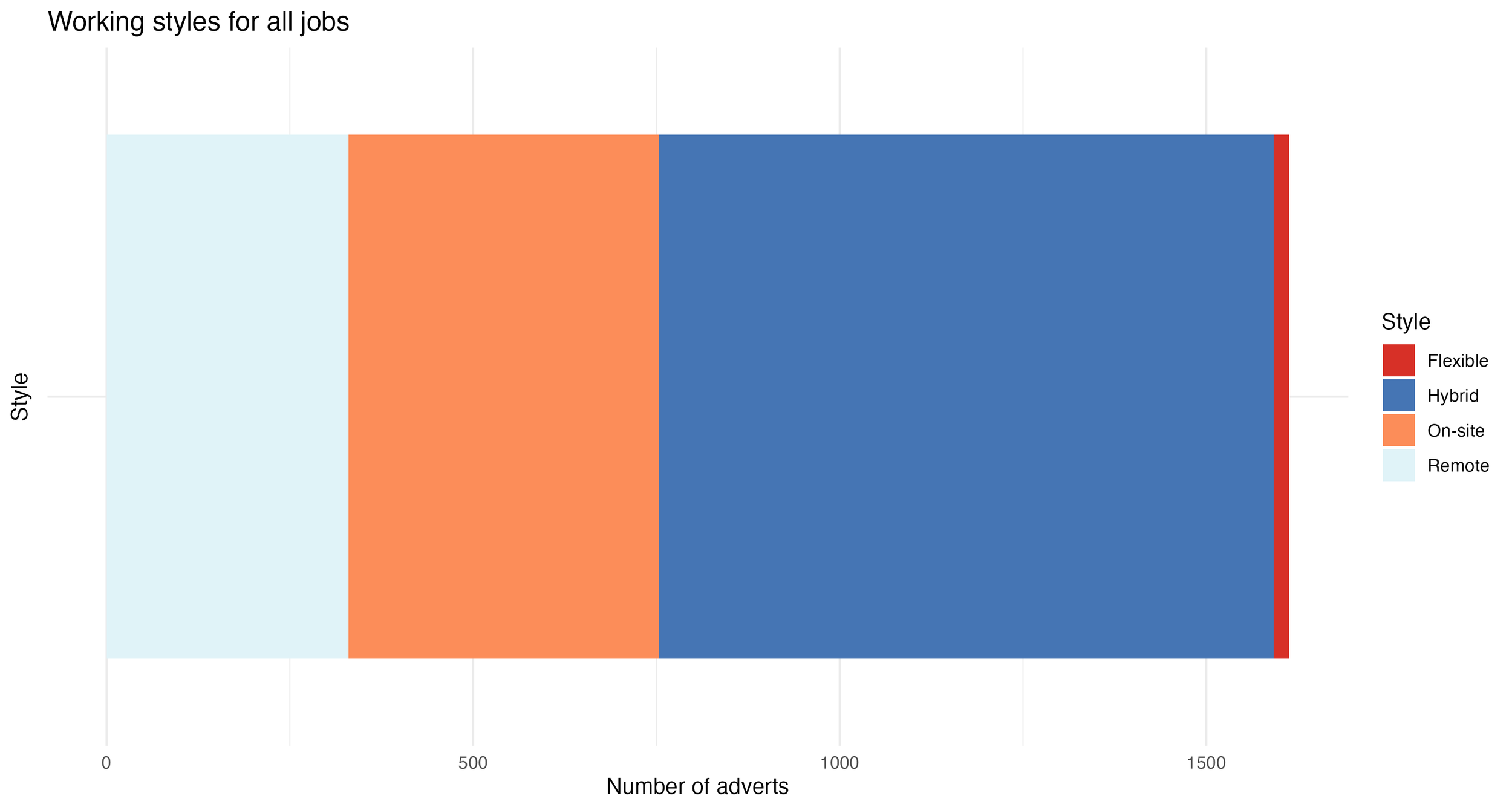
About half of all jobs (52%) are hybrid with the remainder split between remote (20%) and on-site (26%) work. Something to consider if you're advertising a new vacancy.
Location
Where jobs have a location given (for Hybrid or On-Site roles) I have generalised the location into the nations and regions of the UK.
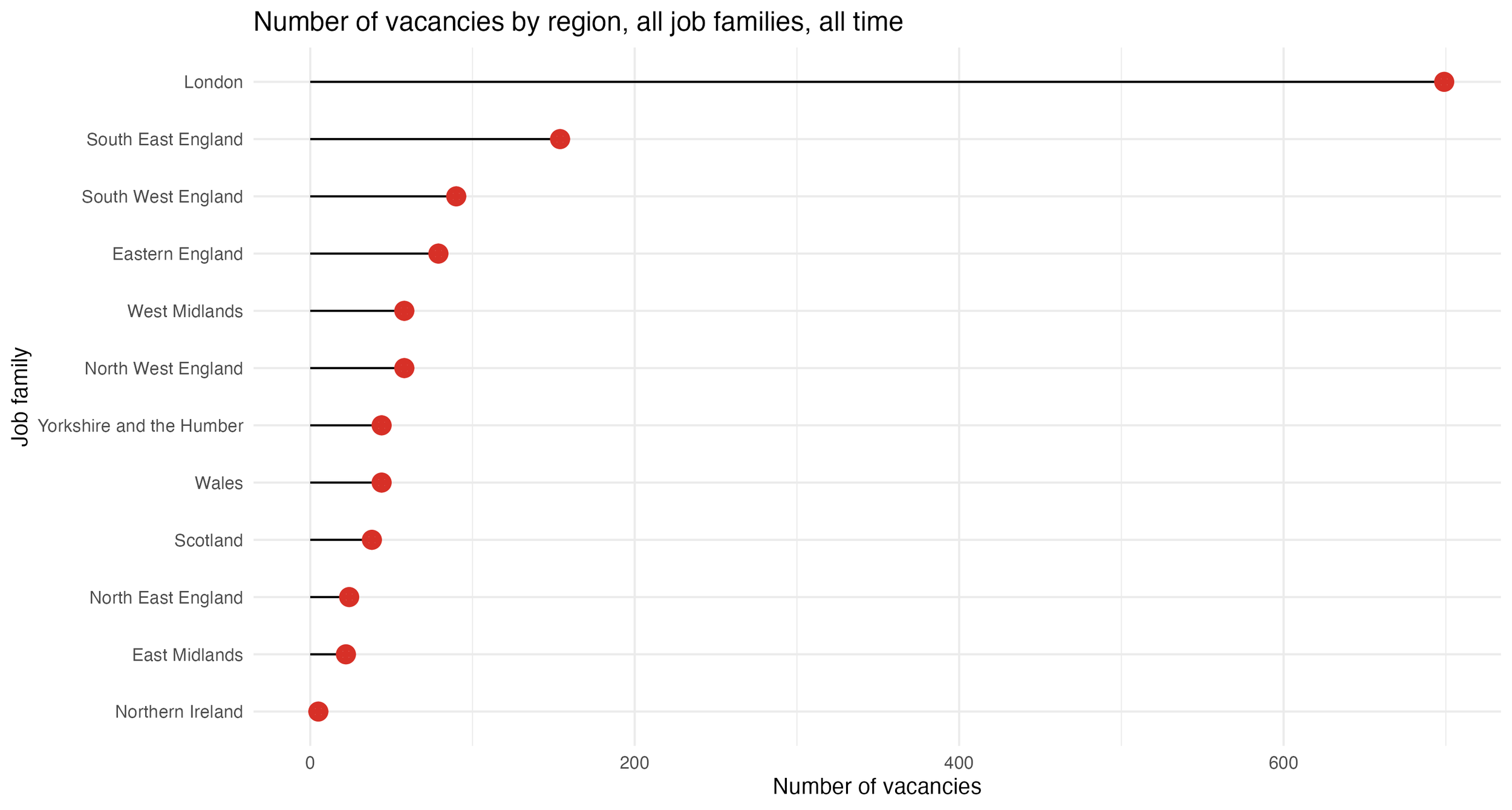
London dominates.
It might be that this dataset is biased by the sources I use to find vacancies. I suspect that Northern Ireland vacancies are more likely to appear in island-of-Ireland media rather than the UK-centric media I'm looking in for example. It might be that organisations based outside London are more likely to allow Remote working as a recruitment incentive. It might just reflect the dominance of London in our economy.
What's next
Over coming weeks I'll have deeper dive into the Manager, Analyst, Officer, Head, Senior Analyst and Admin job families in turn.
Drop me a line with questions or suggestions for analysis.
Hire me
I'm freelance. If you need any help with research or analysis in your organisation. Drop me a line.
If you appreciate the work I do with this newsletter why not Buy me a coffee?
Interesting links weekending 2025-06-08
Interesting links I’ve found
For my reference really but you’re welcome to share
Developing community power standards with Manchester City Council - Interesting and probably standards are helpful but I’d like to see more on the impact
Talking of outcomes TPXImpact re-upped this post from GDS about service outcomes always worth refering to
Talking of outcomes (again) they feature large in Nesta’s test and learn playbook disappointingly this is addressed to UK gov so it may not be too much use in the foothills of localgov
Talking of Test and Learn, nod along to James Plunkett’s Neighbourhoods as engines of change
Principles for services organisations (sort of a maturity assessment) is worth a bookmark
A gonorrhoea vaccine will soon be available in the UK - vaccines are cool
I went to an LGA webinar on financial inclusion and came away with some interesting links including:
A case study of the financial benefits of a credit union’s homeless prevention scheme
Can local No Interest Loan Schemes help low-income households to weather financial bumps in the road? A case study from County Durham
Can we make it safe for kids to play in the streets?
With the exception of London, deprived settlements in England tend to have fewer, smaller and further-away playgrounds. Really interesting. I wonder how this maps onto rural areas where many children may live very far from playgrounds.
This is interesting and I’m going to have to think about it some more to understand it Visualizing as a Form of Collective Care
Another card game for dataviz training (not saying that’s a bad thing)
A webinar on Using Connected Vehicle Data to Gain Enhanced Insights into Road Network Performance <- Interesting though I’m not sure that data is the constraint so much as money to fix potholes on the network

Gen Z employees need the opportunities we had and organisations need to provide them
Over 70% of the nonprofit data jobs I list in my newsletter are remote or hybrid. That has consequences for younger employees and for the organisations that hire them.

Not quite this old. But getting there.
Nearly 30 years ago
My first proper job was in 1996 (after a protracted period as a student) and as with a small local authority. I went into the office every day. I had a phone on my desk (very important as I was a press officer) and a computer of my own.
This was long enough ago that we did not have a council website though we did have email to individuals (really challenging for managers who no longer controlled the flow of conversations around the council).
We had a tea-trolley (which meant you got coffee made as you did not like it served at a time you did not want it, though you did also get gossip about other teams in the council).
Merely 17 years ago
Then since 2008 I have worked in either hybrid or fully remote roles. Since then I've seen a shift in where the median expectation is for organisations. Working mostly in consultancy I would be on the road at least a couple of days a week. Potential clients would suggest I pop in "next time you're in London", current clients would expect workshops, presentations and pitches to be undertaken in person. My Brompton got an awful lot of use.
That shifted with COVID. Suddenly no-one wants a consultant in the office. Initial conversations are Teams calls, workshops are Teams calls, final presentations are Teams calls.
From my point of view this is broadly fantastic. A well designed online workshop can deliver at least as good quality outcomes as a well designed in-person workshop. My addressable market has opened up and my productivity has gone through the roof (I mean I actually enjoy train travel but it's hard to do good quality work on even a long, comfortable train journey).
But I am a middle-aged man in the prime (he says hopefully) of his career. I have a comfortable home office where the only disturbance is from two dogs who do occasionally insist on being walked or fed. I have mature professional networks developed over 30 years of work.
Freezing shared houses
Back in 1996 things were very different. I shared a freezing house with a bunch of artists who kept, let's say, very different hours to me. I had a tiny (though reasonably priced) bedroom and the only potential working surface was the kitchen table. Which was used for other purposes. Only some of them related to the preparation or consumption of food and some of them were inimicable to both.
I was at the start of my career. I knew hardly anyone and I didn't know that much about how to be effective in my profession. I did want to make an impact on my organisation and improve lives for local people.
But I was required to go into an office every day where I had access to a lot of more experienced people who could help me channel my enthusiasm and develop my skills.
So I often wonder what life is like for early career professionals who are, largely, compelled by our crazy housing policies to live in shared accomodation. It was not surprising to read (behind a paywall) that Gen Z is leading the charge back to the office. It's not simply that the office is a better physical place to work than a bedroom or a kitchen table. Early career workers are more likely to want to build new connections, make friends, learn from the middle-aged duffers like myself.
In the world of 1996 a junior employee could reasonably expect to bump into more senior managers in the corridor, before or after a meeting, over a lunch break. You could ask them questions, make naive but enthusiastic suggestions, and become more visible to people who really could affect your career.
Gen Z
How do Gen Z employees manage all this now?
From the FT article above (written by Emma Jacobs and Sapphire Hope) reports:
"One 23-year-old finance worker, who asked to be anonymous says the absence of older managers makes going into the office feel pointless. 'Why would I, as a young person with student debt, say goodbye to around a quarter of my salary just on trains and the occasional coffee?'"
It's a good question and especially relevant to data roles. Based on Hannah Khwaja's analysis of my nonprofit data job newsletter, 71% of advertised roles are hybrid or fully remote.
There are solutions
Organisations need to recognise that all working patterns have trade offs and that these trade offs are different for different people. As well as understanding the recruitment market. A minority of job vacancies are office based but that is potentially to the advantage of an employer if you know you are looking for someone who wants to be based in the office (and therefore will reject the majority of adverts out of hand).
Fully remote organisations have often recognised these challenges and have been intentional about addressing them. MySociety: the civic tech charity holds regular but infrequent physical get togethers in different parts of the UK (I was invited to attend one in Cardiff along with my Mapio Cymru colleagues). Many organisations support remote social activities: online book clubs, fun Slack channels which can help to build networks. All the more so if managers and leaders actively participate.
Even then employers should recognise that not everyone can work from home and should consider funding coworking spaces for employees that would benefit. A harder sell if your organisation is remote to save on office costs.
Be intentional in hybrid working
It is in hybrid working where the risks seem greatest. It is easy to imagine managers filling up their in-office days with meetings with each other and shutting out more junior staff. It is easy to imagine rotas being created to provide "coverage" of the office which spreads team members out over the week and makes it even harder to build relationships.
This is an area that organisations should not leave to chance. Managers and leaders should be understanding what they gain and lose by their working pattern and what the impact is on individuals right now and their career development as well as the opportunities for innovation and resilience for the organisation.
But I do not recommend a return to the tea-trolley.